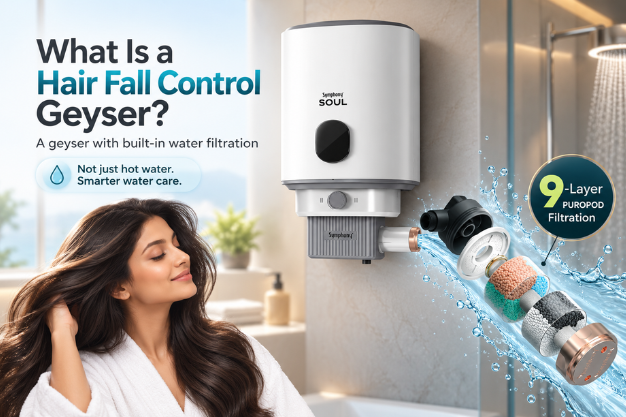
Picture this. You buy the pricey shampoo everyone recommends. You add a conditioner, then a hair mask on Sundays.
Two months later, your hair still feels like straw.
So who’s to blame? The products? Your hair? Or something you’ve never thought to question, like the water in your bathroom?
A Geyser Is Not a Water Purifier (And That’s the Catch)
Here’s a fact that surprises many people. Your everyday geyser only changes one thing about your water: its temperature.
If the water entering it is loaded with calcium and magnesium, the water leaving it is loaded with calcium and magnesium too, only hotter. In fact, heat can make those minerals settle out faster, which is why old geysers and kettles collect that chalky layer inside.
That’s the gap a Hair Fall Control Geyser tries to close.
Okay, So What Does “Hair Fall Control” Actually Mean?
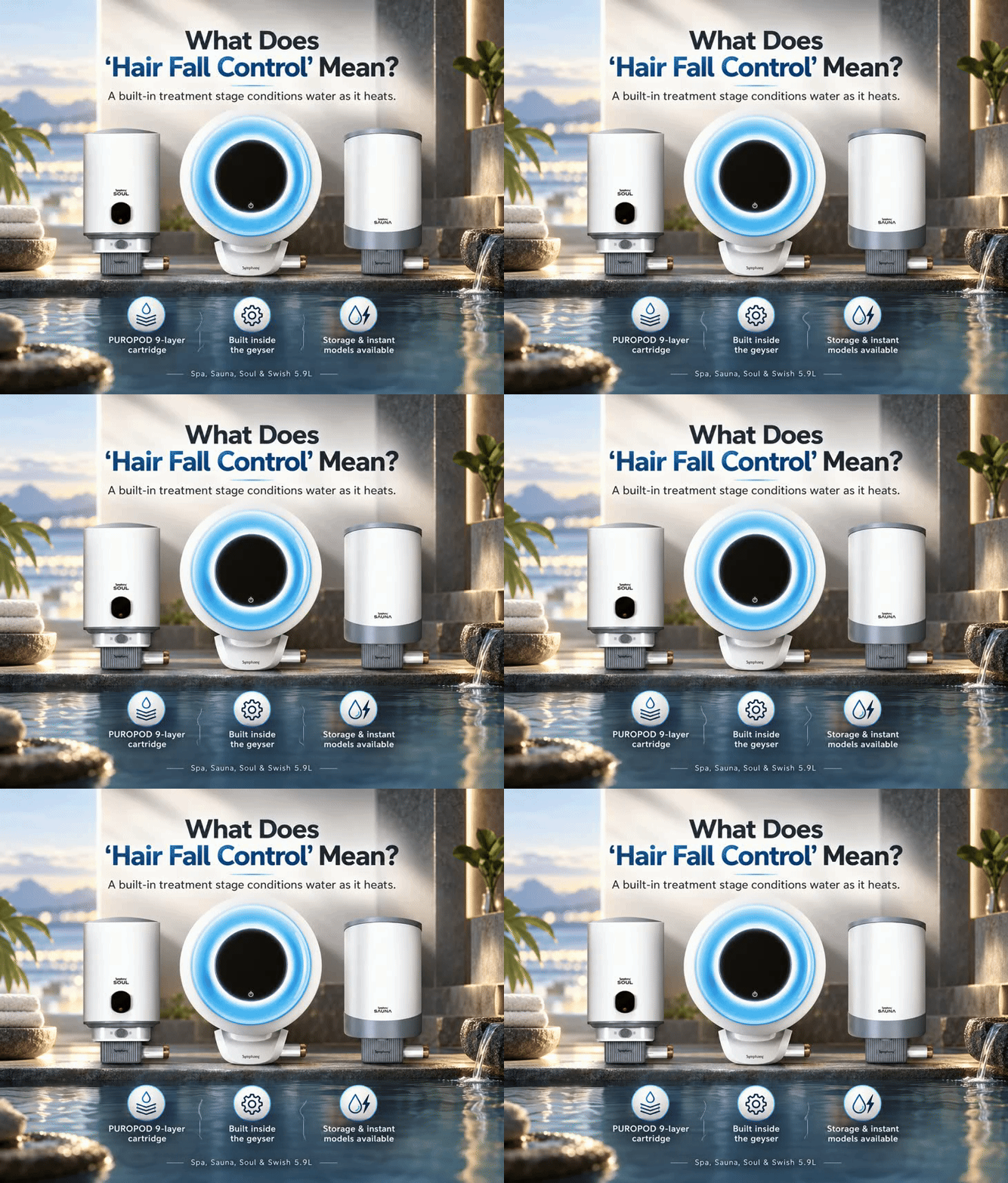
Let’s decode the name. It describes a water heater with a treatment stage built in. As water flows through the unit, it passes a filtration cartridge that is meant to reduce sediments and certain chemicals and condition the water while it heats.
Symphony’s Spa, Sauna and Soul storage geysers use a 9-layer cartridge called PUROPOD for this job. The important detail is where it sits: inside the appliance itself, not as a separate gadget you attach later.
Prefer not to have a tank? Symphony’s Swish 5.9L instant geyser brings the same PUROPOD conditioning together with a 3 kW heating element in an instant format, so you get hot water on demand along with treated water.
Now, a fair question. Does the name promise you’ll stop losing hair?
It doesn’t, and it shouldn’t. Let’s talk about that.
What This Can Do, and What It Can’t
Hair fall has a long list of possible causes: genetics, hormones, diet, stress, scalp health and more. Water quality is only one possible entry on that list.
What treated water can realistically help with is the hard-water side of things: mineral build-up, dryness, a rough texture and the breakage that comes with it.
So keep your expectations sensible:
- It’s a support for your routine, not a cure.
- It works gradually, not after a single bath.
- If your hair fall is heavy or sudden, see a doctor first. Water is rarely the whole story.
Run the Bottle Test at Home
Curious whether your water is actually hard? Try this five-minute experiment before you spend a rupee.
- Fill a clean, clear plastic bottle about one-third with tap water.
- Add a few drops of liquid soap.
- Cap it and shake hard for ten seconds.
- Look at the result.
Big fluffy foam and clear water?
Your water is likely on the softer side.
Weak foam and cloudy water?
That’s a common sign of hardness.
Bonus clue: peek inside your kettle. A pale crust on the base tells the same story.
It’s a rough home check, not a lab report. For a proper number, get your water tested.
Same Water, Two Different Geysers
Imagine two neighbours with identical hard water supply.
| What Happens | Ordinary Geyser | Hair Fall Control Geyser |
|---|---|---|
| Water gets hot | Yes | Yes |
| Water passes a built-in filter stage | No | Yes |
| Minerals left largely untouched | Yes | Designed to be reduced |
| Extra product or device needed | Possibly | Not for this purpose |
Both give you a hot bath. The difference lies in what the water carries when it reaches you.
Choosing the Right Format for Your Bathroom
Before you hunt for the best hard water geyser, decide which format suits your space and habits. Ask yourself:
Who uses hot water, and how much?
A family with a full bathroom routine is usually better off with a storage model. If you only need a quick splash at the basin or kitchen tap, an instant unit or the best 3l geyser for hard water in your price range may be enough.
Is your wall short on height?
Then a horizontal design could work where an upright one can’t. When comparing the best horizontal geyser for hard water, check the mounting space first, then the treatment features.
Do you want hot water on demand?
Then look at the best instant geyser for hard water. Symphony’s Swish is one example, an instant geyser with PUROPOD built in. One warning: speed doesn’t equal treatment. An instant geyser without a filter stage delivers hard water faster, nothing more.
Since availability differs by range, confirm which sizes and formats a specific model comes in before you decide.
A simple filter for any recommendation you read:
- Does it treat water, or just heat it?
- Is the tank built to resist corrosion, ideally with a magnesium anode rod?
- Does the capacity and pressure rating match your home?
Questions You Might Be Asking
What is a Hair Fall Control Geyser?
It's a water heater with an in-built filtration cartridge that conditions water as it heats. It targets hard-water-related dryness and residue and is not a medical treatment.
Who benefits most from one?
People in hard water areas who notice scale, weak lather, or rough hair and dry skin after bathing. If your water is already soft, the benefit may be small.
When should I expect to see a change?
Give it time. Hard water effects build slowly, and reversing your exposure is a gradual process, so think weeks rather than one shower.
Where is the filter located?
In these geysers, the cartridge sits inside the unit, so the water passes through it while being heated. No separate attachment is needed.
How can I tell if my water is hard?
Try the bottle test above, check your kettle and taps for white crust, and confirm with a proper water hardness test.
How is this different from switching hair products?
Products treat your hair after it has already met the water. A treated supply changes the water itself. The two work best together.
Which is better for hard water, instant or storage?
Neither is automatically better, and Symphony's hair fall control range covers both: Spa, Sauna and Soul are storage geysers, while Swish is an instant geyser. Pick by how much hot water you need and how much space you have, then make sure the model includes treatment.
What should I check before buying?
Look at tank corrosion resistance, a magnesium anode rod, pressure rating, energy rating, and how easy the cartridge is to replace.
Before You Buy Your Next Water Heater
Shopping lists usually start with litres and watts. Try adding one line at the top:
“What happens to my water on its way to me?”
Answer that first, and the rest of the decision gets much easier.