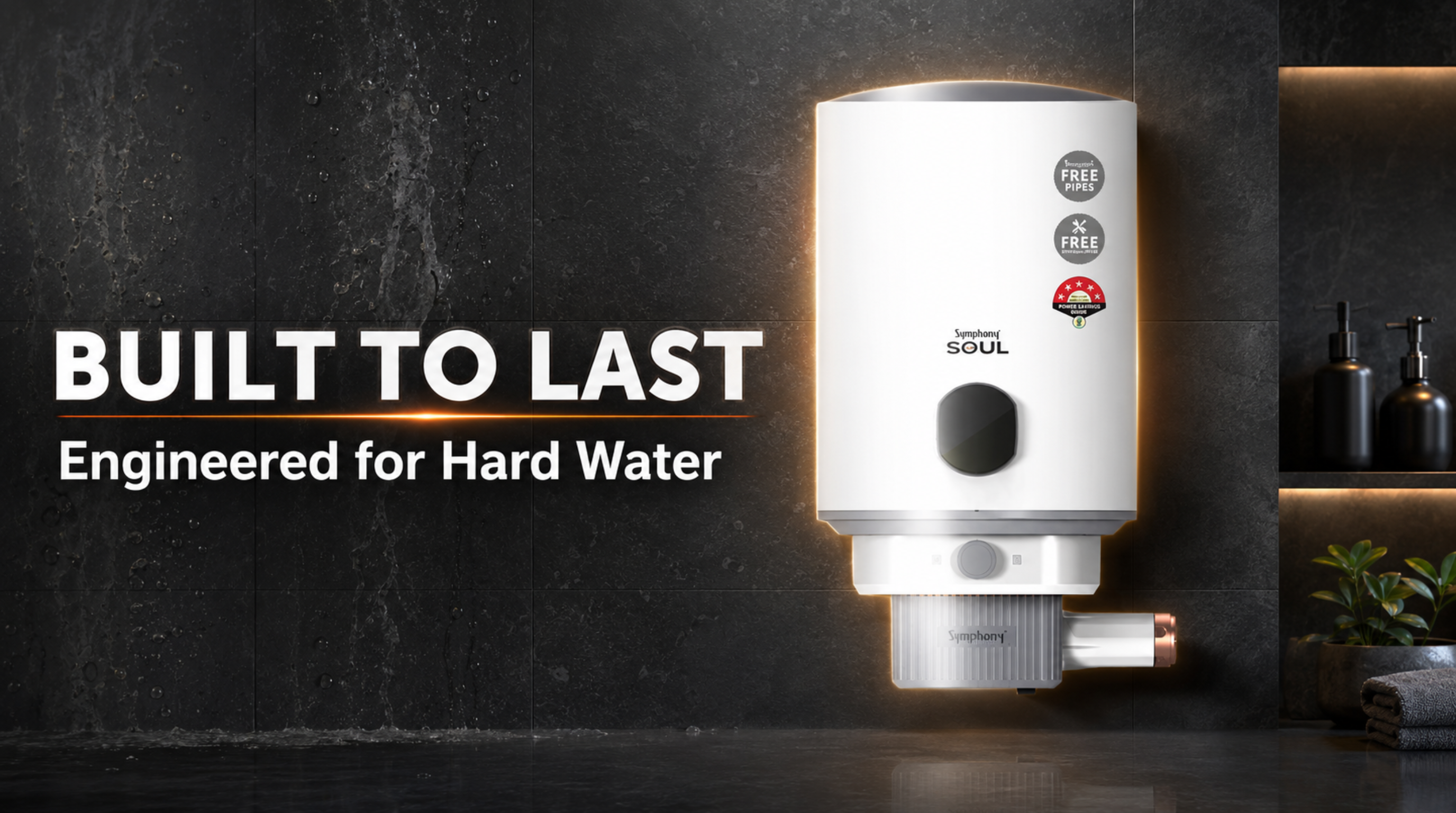
Ask anyone who has owned a geyser for more than a few years in a hard water area, and you will hear the same story: the heating element scales up, the tank starts rusting from the inside, and the water heats slower every winter until the unit finally fails, usually earlier than the seller promised.
This is not bad luck. Most of India’s tap water carries dissolved minerals that are hard on internal metal components over time, and a geyser built without that reality in mind will always underperform its rated lifespan. When you search for the best geyser for hard water or an instant geyser that can handle years of daily use, what you are really evaluating is what happens inside the tank, not just the specifications on the box.
Here is what Symphony builds into every unit to specifically address this.
Titanium PRO™ Glassline-Coated Tank
The inner tank is where a geyser’s real durability battle is fought. Symphony’s Titanium PRO™ Glassline coating gives the inner tank strong resistance to corrosion, rust, and the specific kind of damage hard water causes over repeated heating cycles. Because this resistance is built into the tank surface itself, it protects the unit from the inside out, extending the geyser’s working life well beyond what an uncoated tank would deliver in the same water conditions.
Incoloy Glass-Coated Heating Element
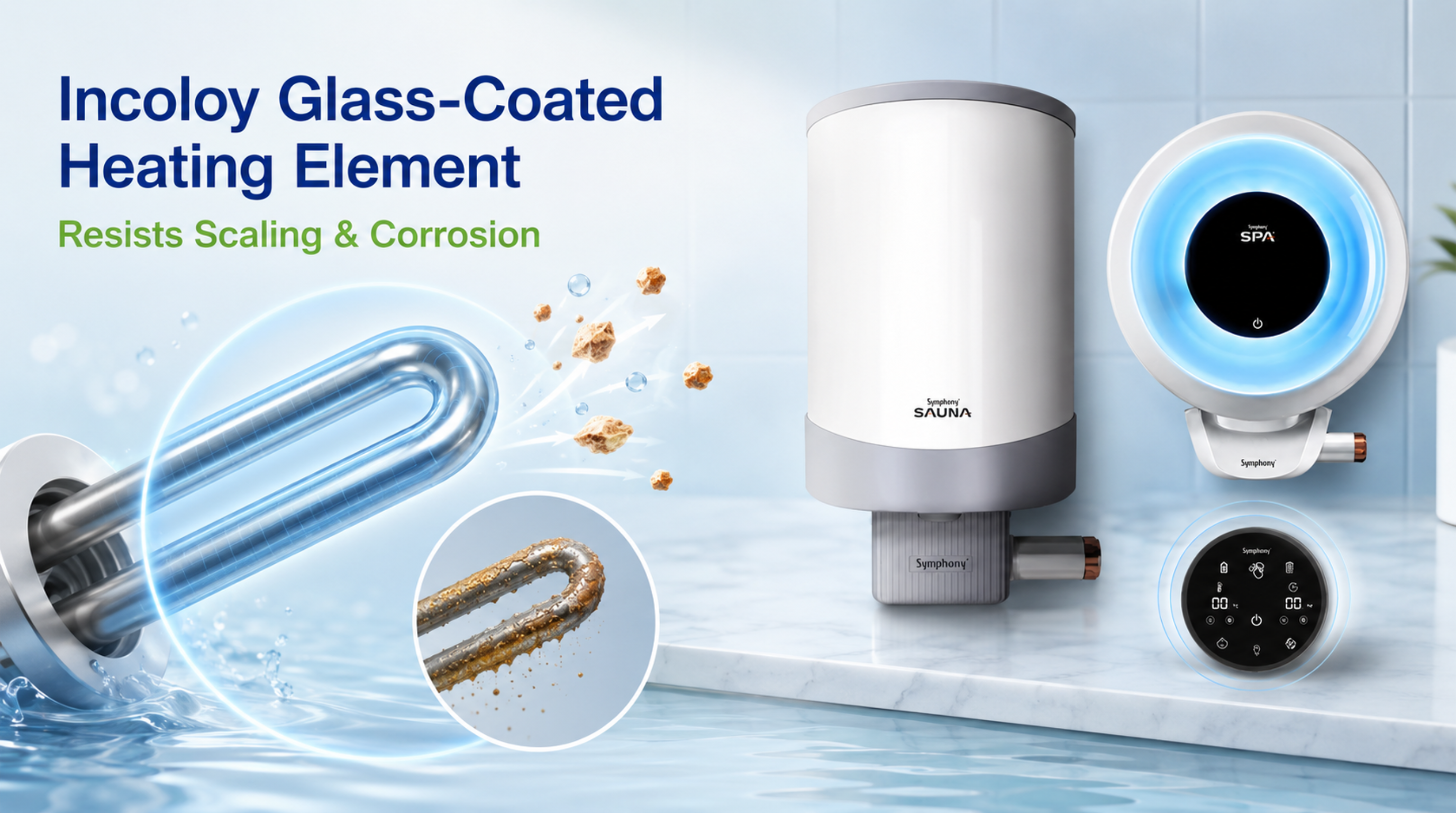
The heating element is the component doing the actual work, and it is also the component most exposed to mineral scaling. Hard water deposits build up on an exposed element over time, forcing it to work harder to heat the same volume of water, which wastes electricity and shortens its life.
Symphony’s Incoloy heating element carries a glass coating specifically to resist this scaling and the corrosion that comes with it. The result is faster heating, better energy efficiency sustained over years rather than months, and long-lasting performance even in water that would quickly degrade a standard element.
Magnesium Anode Rod: Sacrificial Protection
This is one of the more overlooked features in water heater design, but it is doing quiet, continuous work. A magnesium anode rod is designed to corrode before anything else in the tank does. It actively attracts the corrosive minerals present in hard water, drawing that damage onto itself rather than the tank wall or the heating element.
This sacrificial protection significantly increases the working lifespan of both the tank and the heating element, because the parts that are expensive and difficult to replace are shielded by a component that is doing its job precisely by wearing down first.
Superior PUF Insulation: Efficiency That Compounds Over Time
Durability is not only about resisting damage, it is also about how efficiently the unit runs every single day, since that efficiency compounds into real electricity savings over the geyser’s life.
High-density PUF insulation minimizes heat loss from the tank, keeping water hot for longer after each heating cycle. This reduces how often the geyser needs to reheat stored water, which lowers electricity consumption while ensuring hot water is available whenever you actually need it, not just right after the unit switches on.
8 Bar Pressure Capacity and a Heavy-Duty Heating Element
Build quality also has to account for where and how the geyser is actually installed. Homes in high-rise apartments, or homes using pressure pumps, put real mechanical stress on a water heater that a ground-floor, gravity-fed installation never experiences.
Engineered for up to 8 bar pressure, Symphony geysers are built for exactly these conditions, delivering reliable and safe performance even under high water pressure rather than being a best-effort fit for it.
The heavy-duty heating element backs this up with robust construction designed to heat water quickly while maintaining efficiency, so performance stays consistent and hot water arrives faster, heating cycle after heating cycle, year after year.
Which Symphony Geyser Fits Your Water Conditions?
Build quality features are not identical across every model, since different Symphony geysers are engineered for different homes and water conditions.
- Symphony Sauna: built for high-rise buildings, with 8-bar pressure capacity, a shock-proof body, and the glass-coated Incoloy heating element for long-term durability under pressure.
- Symphony Soul: pairs the Titanium PRO™ Glassline-coated tank with an LED temperature display and PuroPod filtration for added longevity in hard water areas.
- Symphony Spa: a premium storage geyser (10L/15L/25L) with 9-layer PuroPod filtration and a smart bath controller, softening water before it reaches the tap.
- Symphony Soul HL: the same durability engineering in a horizontally designed, space-saving format.
- Symphony Selesta and Symphony Sypher: everyday storage geysers with adjustable temperature control, built for consistent daily performance.
- Symphony Swish: a compact instant electric geyser for kitchens and smaller bathrooms, for quick, everyday hot water needs.
Every model in the range carries a 5-star energy rating and the same warranty backing: 7 years on the inner tank, 3 years on the heating element, and 2 years on the overall product, with free installation support.
Why Water Quality Matters as Much as Heating Technology
Hard water does not only shorten a geyser’s lifespan, it also affects the people using it every day. Mineral-heavy water can lead to scaling inside the tank and, over time, has been linked to hair fall and dry skin with regular use. This is why filtration is increasingly part of the durability conversation, not a separate feature. Symphony’s PuroPod filtration, available on the Spa and Soul ranges, softens water before it reaches the tap, protecting both the appliance and the people using it.
What This Means for Your Decision
Every one of these features exists because of the same underlying problem: Indian tap water is hard on geysers, and most of a unit’s visible lifespan is decided by components you never see, the tank coating, the element material, the anode rod, and the insulation quality.
A geyser that looks identical to a competitor on the outside can perform very differently after two years of daily use in hard water. Symphony’s Titanium PRO™ tank, Incoloy element, magnesium anode rod, PUF insulation, and pressure-rated construction are built specifically to hold up where ordinary units start to fail, so the geyser you install today is still performing the way it should years from now. Explore Symphony’s full geyser range and find the model built for your water conditions.
Geyser Build Quality: FAQs
Does hard water really damage a geyser?
Yes. Hard water contains dissolved minerals that cause scaling on the heating element and corrosion inside the tank over time, which is why tank coating and element material matter as much as capacity when choosing a geyser.
What is a magnesium anode rod and do I need one?
A magnesium anode rod is a sacrificial component that corrodes before the tank or heating element does, actively drawing corrosive minerals onto itself. It significantly extends the working life of both the tank and the element, especially in hard water areas.
What does 8-bar pressure capacity mean?
It means the geyser is engineered to safely handle water pressure up to 8 bar, which makes it suitable for high-rise buildings and homes using pressure pumps, where standard geysers may not perform reliably.
Does PUF insulation actually reduce electricity bills?
Yes. High-density PUF insulation reduces heat loss from the tank, so stored water stays hot for longer and the geyser reheats less often, which lowers electricity consumption over time.
Which Symphony geyser is best for hard water areas?
Symphony Soul and Symphony Spa are best suited to hard water areas, combining the Titanium PRO™ Glassline-coated tank with PuroPod filtration that softens water before it reaches the tap.
What warranty does Symphony offer on tank and heating element durability?
Symphony offers a 7-year warranty on the inner tank, 3 years on the heating element, and a 2-year comprehensive product warranty, reflecting the durability engineering built into the Titanium PRO™ tank and Incoloy element.