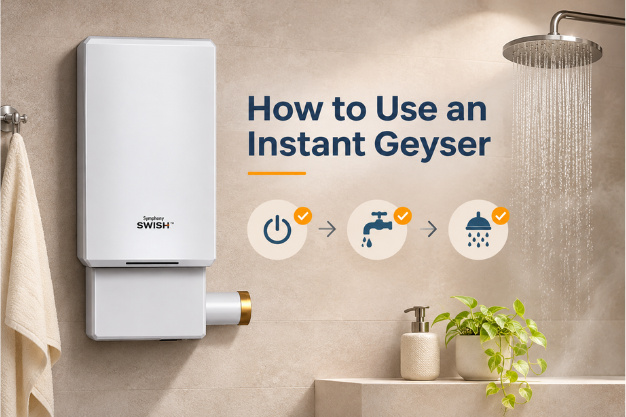
Ever stepped into the shower expecting warm water and got a lukewarm trickle? Or a burst of heat, then a sudden chill?
Here’s the thing most people miss. An instant geyser doesn’t behave like the tank-based geyser many of us grew up with. If you use it the old way, it will let you down. Use it the instant way, and it works beautifully.
Instant Geysers Work Differently, So Use Them Differently
A tank geyser heats water in advance. An instant water heater heats water while it flows past the element. No flow, no heat.
Symphony’s own instant range operates only when water is flowing, which also means no standby heat loss. So the tap, not the dial, is your real control. Keep that one idea in mind and the rest of this guide gets easy.
The Flow and Heat Balance Nobody Explains
An instant geyser has a fixed amount of heating power. Think of it like a hot plate with a limit. Push a lot of water past it and the water barely warms. Slow the flow, and it heats up nicely.
As a rough guide, a 3 kW element can lift only about one and a half to two litres per minute by a comfortable amount. Your inlet water temperature and model will change this, so treat it as a ballpark, not a promise.
Try this quick bucket test:
- Open the tap to the flow you normally use.
- Time how long a 10 litre bucket takes to fill.
- If it fills in a minute or two, your flow is likely too strong for good heating.
- Ease the tap down and test again.
Found a sweet spot? Remember that tap position. It’s your best friend.
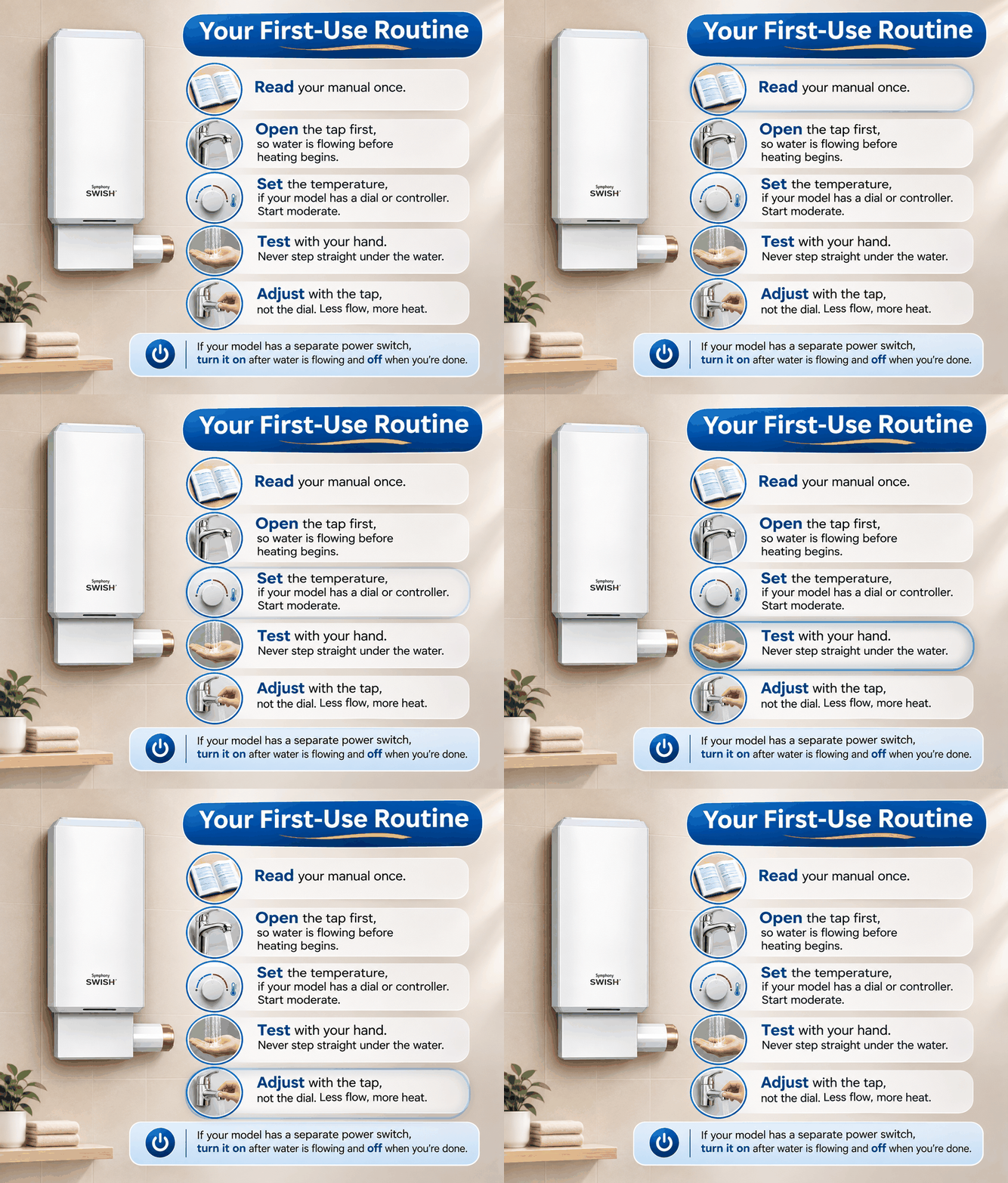
Your First-Use Routine
Keep it simple:
- Read your manual once. Models differ, and the manual wins.
- Open the tap first, so water is flowing before heating begins.
- Set the temperature, if your model has a dial or controller. Start moderate.
- Test with your hand. Never step straight under the water.
- Adjust with the tap, not the dial. Less flow, more heat.
If your model has a separate power switch, turn it on after water is flowing and off when you’re done.
Basin, Bucket or Shower? Match the Job
Not every use asks the same from an instant geyser. Which one sounds like you?
The basin and kitchen person. Small, quick bursts suit it perfectly. This is where instant units shine.
The bucket bath person. Symphony notes its instant heaters suit bucket baths. Fill slowly at a gentle flow and you get properly hot water.
The shower person. Quick showers work well, especially with a low flow shower head. A strong, drenching flow will cool the water, so go gentle.
Troubleshooting Game: Which Case Is Yours?
Case A: lukewarm no matter what.
Flow is probably too strong. Reduce it and wait a few seconds.
Case B: hot, then cold in bursts.
Check for fluctuating supply pressure, then check the manual for safety cut-out behaviour.
Case C: no heat, no indicator.
Check the plug, socket and switch. Still nothing? Call a technician. Don’t open the unit.
Case D: flow gets weaker over weeks or months.
Scale could be building inside. Read on.
What Hard Water Does to an Instant Geyser
Do you see a chalky crust in your kettle? Does soap lather poorly? Your water may be hard.
In instant units, water moves through narrow channels, so scale can narrow them over time. That means weaker flow and drifting temperatures. Follow your manual’s cleaning guidance, and consider a water hardness test.
Winter or Summer: Why Your Tap Setting Should Change
Here’s something that surprises many people. The same tap position can give very different results across the year.
In winter, incoming water is colder, so the element has more work to do. Ease the flow down a little. In summer, the water starts warmer, so you can open the tap more and still get comfortable heat.
Think of it as a seasonal habit. A quick check with your hand each time keeps you in control.
Small Fixes That Make a Big Difference
- Choose a low flow shower head. It lets the geyser keep up without a weak, dribbly feel.
- Keep taps and shower heads clear. Scale can make the flow uneven, which makes temperature uneven too.
- Stay patient for a few seconds. Hot water takes a moment to travel through the pipes.
Do and Don’t Cheat Sheet
Do
- Open the tap before expecting heat
- Keep the flow gentle for hotter water
- Test the water with your hand first
- Follow your manual for your exact model
Don’t
- Touch switches with wet hands
- Ignore drips or loose fittings
- Point shower spray at the unit
- Open the unit yourself if something seems wrong
The Honest Bit: What It Won’t Do
- It won’t give a long, powerful, high-flow shower for several people in a row.
- It won’t give hot water when the power is out.
- It heats water. It doesn’t remove hard water minerals by itself.
Not a flaw, just a job description. Pick it for quick, on-demand hot water.
Where Symphony’s Swish Fits In
If hard water bothers you, look for an instant geyser that also treats water. Symphony’s Swish 5.9L combines a 9-layer PUROPOD cartridge with a 3 kW, 100 percent copper heating element, rated for 6.5 bar pressure for high-rise buildings.
PUROPOD conditions hard water to support healthier-looking hair and gentler bathing. It’s not a medical treatment, and hair concerns have many causes. Check symphonylimited.com for the full Swish range.
Quick Answers to Common Questions
What is an instant geyser?
It's a water heater that heats water as it flows, with no tank, so hot water arrives within seconds.
Who should use an instant water heater?
People who want quick hot water for the basin, kitchen, bucket baths or short showers, or who have limited space.
When should I switch it on?
Open the tap first. Symphony's instant heaters operate only while water flows, and if your model has a power switch, turn it on once water is running.
Where should I mount it?
Keep it clear of direct shower spray and near the point of use. Wiring and earthing should be done by a qualified electrician, as your manual directs.
How do I get hotter water from it?
Lower the flow. The heating power is fixed, so less water means higher temperature.
How is it different from a storage geyser?
Instant units heat on demand. Storage units heat a tank in advance.
What should I weigh before comparing instant geyser price?
Look beyond the sticker. Warranty, service support, installation and running costs all shape what you really pay.
Which is the best instant geyser for hard water?
Look for one that treats water as well as heating it, and compare the details on the brand's site.