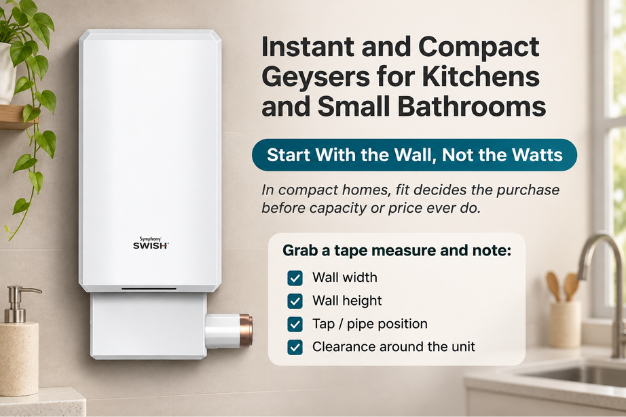
Picture this. You’ve found the perfect spot for hot water in your kitchen. Then you realise the wall is narrower than the box the geyser came in.
It happens more often than you’d think. In compact homes, fit decides the purchase before capacity or price ever do.
Start With the Wall, Not the Watts
Most people compare litres and power first. Try flipping the order.
Grab a tape measure and note:
- Free wall height and width. Include space for pipes and the mounting bracket.
- Clearance around the unit. Cabinets, shelves and windows can get in the way.
- Where water and power already are. Closer is usually simpler.
- Splash zones. Keep the unit away from direct spray from taps and showers.
Write your numbers down. Now every product page becomes a quick yes or no.
Where Do Compact Geysers Actually Go?
Think about the spot, not just the product.
Kitchen: Short, frequent bursts of hot water for dishes and cleaning. An instant geyser for kitchen use suits this rhythm.
Basin or washroom corner: Hot water for hands and face, with little space to spare.
Utility area: Hot water for cleaning chores, away from the main bathroom.
Small bathroom: Steady, longer use. This is where you’ll need to think harder about capacity.
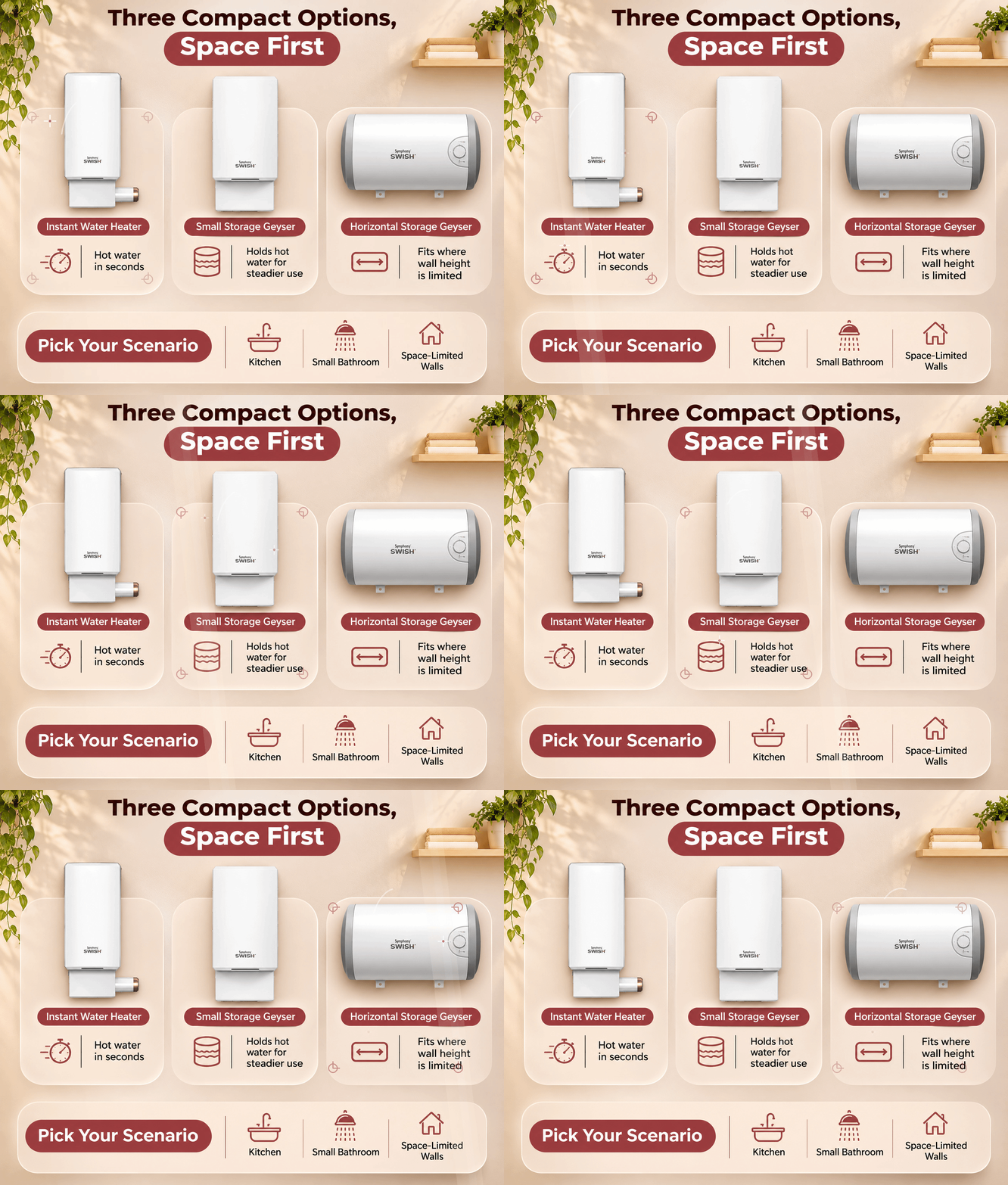
Three Compact Options, Space First
The instant water heater. Smallest footprint, hot water in seconds, no tank to heat.
The small storage geyser. Slightly larger, but holds hot water ready for steadier use.
The horizontal storage geyser. Mounted lengthwise, so it can fit where wall height is limited. Symphony’s Soul HL is one example of a horizontal storage model.
Which one matches your wall and your habits?
Pick Your Scenario
- “I only need hot water for dishes.”
A compact instant unit is usually enough.
- “One or two people share a small bathroom.”
A small storage unit, or an instant water heater for bathroom use if showers are short.
- “My wall is low, but wide.”
Look at horizontal designs.
- “I want hot water at two places.”
Think about one unit per spot rather than stretching one geyser across both.
The Honest Bit: Small Has Limits
A compact geyser won’t suit every job.
- Very small units can struggle with long, strong showers.
- Instant units need power to work at all.
- A tiny tank empties quickly with several users.
So size for your busiest moment, not your quietest.
Kitchen or Small Bathroom: How the Needs Differ
The two rooms ask different things from a geyser.
In the kitchen, hot water comes in short, frequent bursts: a quick rinse, a pan, a few seconds at the sink. Waiting for a tank to heat rarely makes sense here.
In a small bathroom, demand is steadier and longer. A shower can run for several minutes, so how much hot water the unit can supply matters more than how quickly it starts.
So ask yourself: is my use short and frequent, or longer and steady? Your answer points you towards instant or storage.
A Five-Minute Routine Before You Buy
- Measure your space. Use the checklist above.
- List who uses hot water, and for how long. Be honest about the longest use.
- Check your water. Scale, weak lather and a crusty kettle are clues to hard water.
- Shortlist two or three models that fit the wall and your usage.
- Compare safety, warranty, service and price across that shortlist.
Five minutes now can save a returned geyser later.
Common Mistakes in Small Spaces
- Buying for looks alone. A neat unit still needs the right capacity.
- Ignoring clearance. Pipes, brackets and cabinets all take space.
- Choosing the smallest size to save money. It can cost more if it can’t keep up.
- Skipping professional installation. Heaters need proper wiring and earthing.
Quick safety reminders: keep hands dry around the switch, keep sprays pointed away from the unit, and call a technician if you notice leaks, sparks or odd smells.
What to Compare Besides Size
Once it fits, compare these:
- Safety protections against overheating and pressure
- Energy rating, such as 5 star, for running costs
- Tank quality in storage models, since corrosion resistance matters
- Service support where you live
- Water quality handling, if your water is hard
Hard water can build scale faster in compact units because water flows through narrow channels. A water hardness test is worth doing.
Where Symphony Fits In
Symphony’s Swish is its instant geyser range, with a Swish 5.9L that includes a 9-layer PUROPOD cartridge and a 3 kW heating element, and a Swish 3 L for smaller needs. Check the product page for what each model includes.
For tank-based hot water, Spa, Sauna and Soul are Symphony’s hair fall control storage geysers with PUROPOD. PUROPOD conditions hard water and isn’t a medical treatment, so see it as one helpful part of your routine.
Thinking About Price the Smart Way
Many people search geyser price first. A better question: what will it cost over time?
Compare the purchase price, installation, warranty and service, and running cost. Then confirm the current price of your exact model before you buy geysers. When you read lists of top water heater brands, use them as a starting point, not a verdict.
Questions You Might Be Wondering About
What is a compact geyser?
A small water heater built for limited space, such as a kitchen or small bathroom. It may be an instant unit or a small storage model.
Who should choose an instant geyser for a kitchen?
People who need quick, small amounts of hot water for dishes and cleaning without a tank.
When is a small storage geyser a better fit?
When several people use hot water, or showers are longer, since a tank keeps a bigger supply ready.
Where is the best spot for a compact geyser?
Near where you use the hot water, with clearance around it and out of the splash zone. Have a qualified electrician handle the wiring.
How do I choose the right capacity?
Think about your busiest use, not your lightest. Small spots may need around 3 litre, small bathrooms more, and families more still.
How is a horizontal geyser different from a vertical one?
A horizontal unit is mounted lengthwise and suits limited wall height. A vertical unit stands upright.
Which is better for a small bathroom, instant or storage?
Storage suits longer showers and more users. Instant suits short, small-volume use.
How can I compare geyser prices fairly?
Match like with like: same capacity, same type, similar features. Then add installation, service and running costs to the picture.